
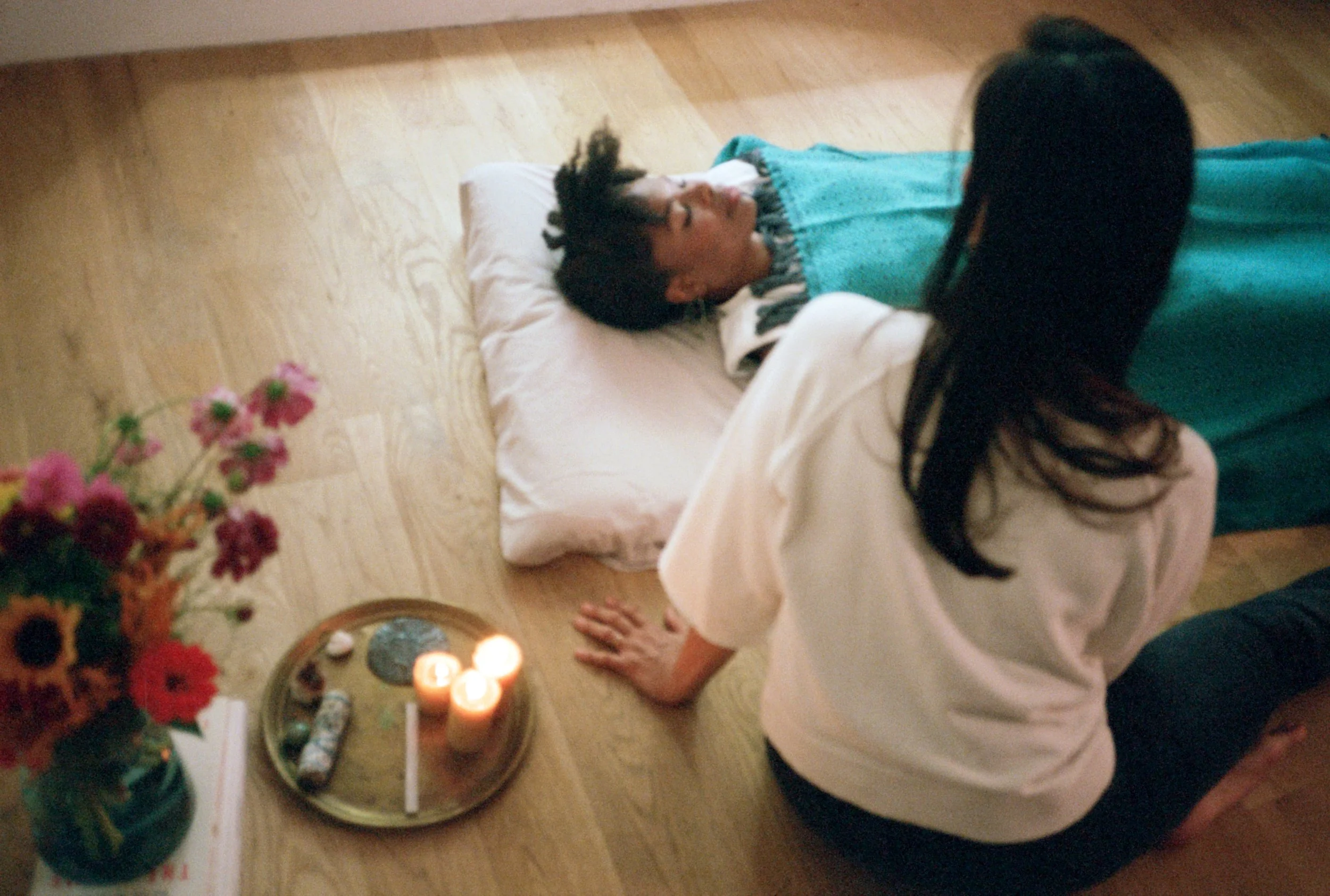
What is Breathwork Mastery RBM?
A gentle, self-generated practice for becoming more aware of how you experience your life—and discovering what becomes possible when you meet yourself differently.
There are many different approaches to breathwork. Breathwork Mastery RBM is about so much more than just the breath.
Breathwork Mastery RBM (or Rebirthing Breathwork Mastery) uses conscious, connected breathing to bring your attention into your body and into the present moment. Rather than forcing the breath, pushing toward an emotional release, or trying to make a particular experience happen, you work with your breath in a way that is relaxed, curious, and responsive to what is already happening.
It is a tool for conscious, intentional living, which over time, with increased awareness, can allow us to move from a reactive space to a creative space.
The process is self-generated. Your breath, your body, and your awareness are doing the work. My role is not to direct your experience or tell you what something means, but to create a safe and supportive space for you to listen more closely to yourself.
Intention is where we begin
Each RBM session begins with an intention.
An intention is different from a goal. Rather than focusing on something you need to accomplish or fix, we explore how you would like to feel, experience, or create in your life.
Sometimes you arrive knowing exactly what your intention is. Sometimes you don't. We take the time to listen for what feels meaningful and true, and to distill it into something you can bring with you into the breath cycle.
The intention gives the session a direction without determining where it needs to go.
Letting the breath lead
Once you begin breathing, there is nothing you need to force.
RBM uses a gentle, conscious, connected breath, in and out through the nose, with awareness of the sensations and changes happening in your body. You might notice physical sensations, emotions, thoughts, memories, images, shifts in awareness, or simply a greater sense of quiet and presence.
There is no particular experience you are supposed to have.
Your experience may be subtle or expansive. You may notice something you hadn't been able to see before, feel something move through, discover a new perspective, or simply experience yourself with more space and awareness.
The instruction is to stay present with what is here, bringing awareness to it exactly as it is, and allowing your own unique process to unfold.
A different relationship with yourself
One of the things I appreciate most about RBM is that it doesn't ask you to figure yourself out from the outside.
You don't have to analyze why you feel a certain way or convince yourself to think differently. Instead, you have an opportunity to experience yourself directly—to notice what happens when you slow down, listen inward, and allow your body and breath to do the work of moving you step by integrated step closer to your intention.
Over time, this can create new reference points for how you relate to yourself, your emotions, your relationships, and your life.
This is part of what RBM means by self-mastery: not controlling yourself, but becoming more aware of yourself and increasingly able to participate in your life with intention rather than simply moving from old patterns of reaction.
The role of the practitioner
RBM is self-generated, but it isn't something you have to do alone.
My role is to be present with you without imposing an agenda on your experience. I offer support around intention-setting, remain available to you while you are breathing, and help you explore what you've experienced afterward.
I don't interpret your experience for you or tell you what your body is trying to say.
Instead, we stay curious.
What did you notice?
What changed?
What felt different?
How does what you experienced relate to the intention you brought into the session?
The meaning belongs to you.
What an RBM session looks like
A session begins with conversation and intention-setting. We take time to understand what is alive for you and what you would like to create or experience.
You'll then settle into a supported position and begin the breath cycle. The breath cycle can range from 30 min to 90 minutes, depending on the session length. I remain present throughout, attuning to your experience, offering individualized support while allowing your own process to lead.
After the breath cycle, we take time to debrief and integrate what you experienced. We may explore what you noticed physically, mentally, emotionally, or spiritually, and we include everything that happened while you were breathing as related to your life and your intention.
A day or so after the session I check in with you via email, in order to support your integration as it unfolds at your own pace.
Why RBM?
You might be drawn to RBM because you're:
curious about exploring yourself beyond purely cognitive or conversational approaches
feeling ready for something to shift, but don't necessarily know what that shift needs to be
interested in developing a more embodied awareness of your life
wanting to explore intention and possibility in a way that isn't about forcing yourself to change
looking for a gentle breathwork practice rather than an intense or cathartic experience
interested in exploring non-ordinary states of awareness through a self-generated practice
wanting to deepen an existing meditation, therapy, yoga, or personal growth practice
RBM isn't about fixing what's broken.
It's an invitation to become more fully present to what is already here—and to discover what else might be possible from there.
Breathwork Mastery RBM
RBM was developed by Alakh Analda and has a distinct lineage and training methodology within the broader field of breathwork. The practice emphasizes conscious, connected breathing, body awareness, meaningful intention-setting, self-generated process, and agenda-free facilitation.
I completed the 2-year RBM practitioner training through the School of Breathwork with lineage holder Eleanor Mann, and bring this practice into my work with a deep respect for each person's individual experience, timing, and capacity.
As a practitioner, I am certified by the Global Professional Breathwork Alliance as an Ethically Compliant Breathworker.